
A day after Prime Minister Narendra Modi’s appeal, the announcement sparked discussions across India, as rising global crude oil prices and tensions in West Asia may lead to higher petrol and diesel prices in the country. Automobile and renewable energy sectors welcomed the focus on public transport and EVs, while opposition parties criticized the government over inflation and rising prices. Gold associations also warned that lower gold purchases could hurt the jewellers industry and related jobs.
Context
Due to rising crude oil prices and tensions near the Strait of Hormuz, the PM said people should make responsible choices in daily life. He encouraged citizens to reduce imports and support “Made in India” products because India’s economic strength depends on everyone’s contribution.
India imports a large amount of crude oil, gold, and other essential goods from foreign countries. If global tensions increase, import costs can rise, which may increase inflation, weaken the rupee, and affect the economy. Therefore, the PM asked people to help by saving fuel, reducing unnecessary imports, and buying Indian products.
Important Statistics
India depends heavily on imports for many important goods. In FY26, India’s total import bill is estimated at nearly $775 billion.
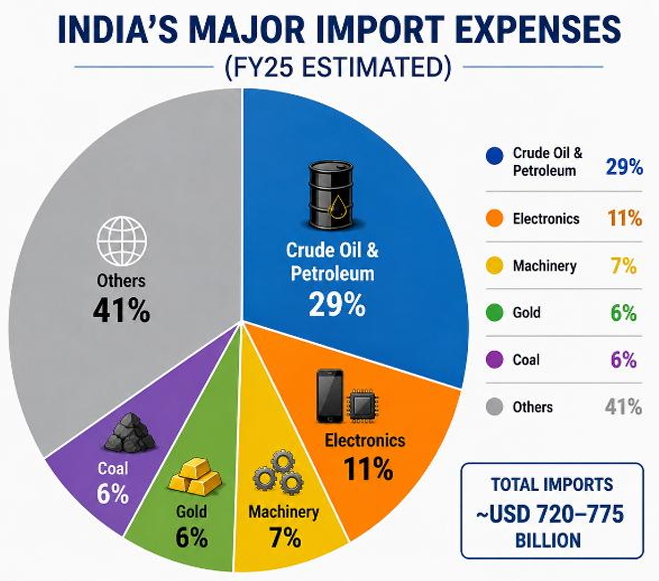
- India imports about 88% of its crude oil needs.
- Gold imports form nearly 6% of total imports.
- India’s forex reserves fell from $728.5 billion in Feb 2026 to $690.69 billion in May 2026.
- India has crude oil reserves for about 60–74 days.
The Indian rupee has weakened against the US dollar, rising from around ₹84–85 per dollar in May 2025 to nearly ₹95–96 in May 2026 due to rising oil prices and global tensions.
Even with strong reserves, higher oil prices can still:
- Increase inflation,
- Raise transport and production costs,
- Weaken the rupee,
- Create pressure on the economy.
Five Things the PM Asked People to Do
- Avoid buying gold for one year.
- Prefer domestic tourism instead of foreign travel.
- Save fuel by using public transport, carpooling, and EVs.
- Use work-from-home and video meetings where possible.
- Buy Made-in-India products instead of imported goods.
Economic Benefits of These Steps
Lower imports of gold and oil will reduce foreign exchange outflow, improve the trade balance, and strengthen India’s external position. Buying Indian products will support local industries, create jobs, and contribute to overall economic growth.
The PM said these steps are not restrictions but precautions to protect India’s economy during global uncertainty caused by:
- The West Asia crisis,
- Problems near the Strait of Hormuz,
- Possible supply disruptions,
- Rising oil prices.
Objective of Government
- To reduce imports, save foreign exchange, and keep the economy stable if the global crisis becomes worse.
- To reduce pressure on foreign exchange reserves and help keep the rupee stronger against foreign currencies.
Probable Scenarios
- Reduced gold demand leading to fall in gold prices.
- Fuel price rise followed by reduction in usage.
- “Vocal for Local” surge and logistical shifts.
- Slower economic growth and tougher times after Covid.
Reducing expenses that result in payments in foreign currency helps lower outflow of foreign exchange and supports efforts to keep the rupee stronger.
Prepared By –
CA Sachin Rokade, Vedant Gilda and Yuvraj Sugandhi